Skip to content
Spectrum Life Academy logo
Crossing the Street visual schedule picture cards for autistic children: Cover
Cover, preview 1 of 7

Crossing the Street

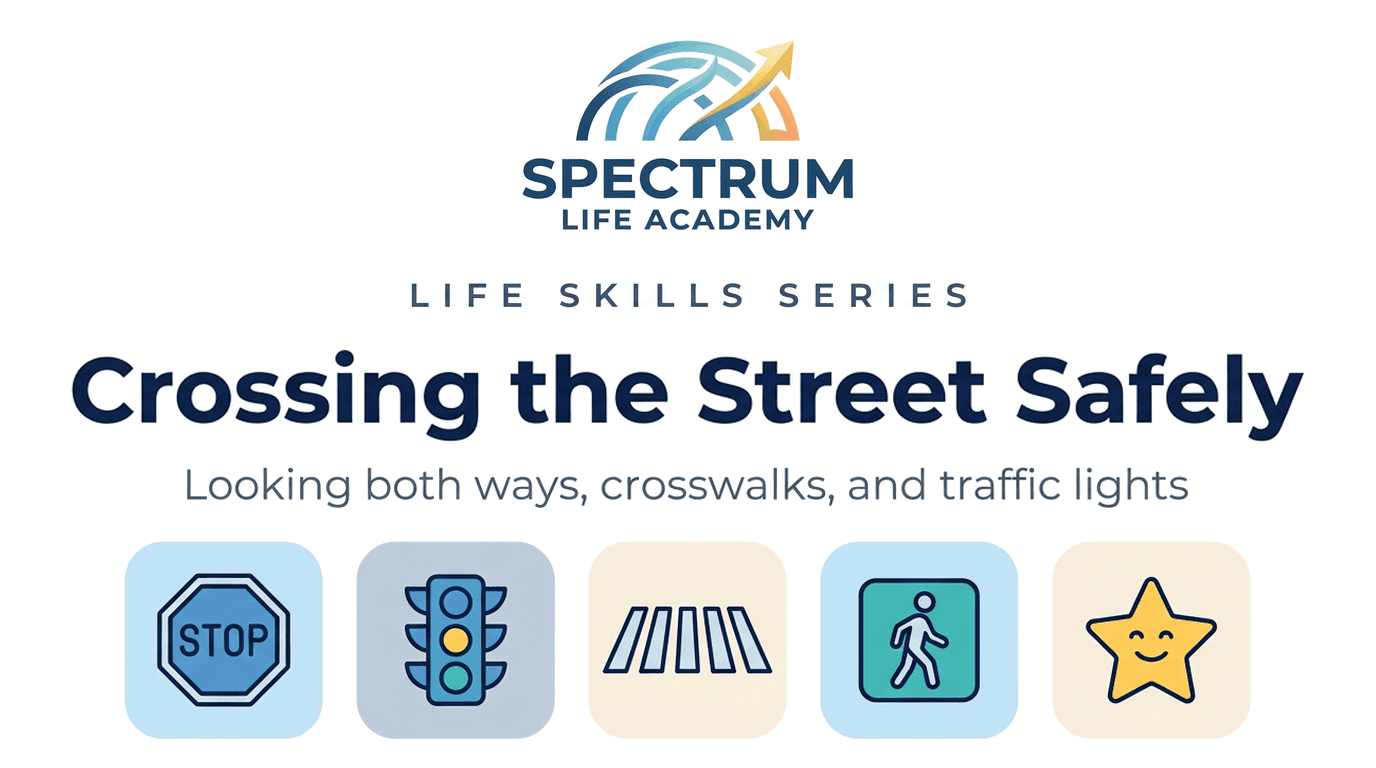
Teach stop, look left-right-left, and listen, plus crosswalks and walk signals, with a social story to practice before heading outside.

Ages
4–12
Pages
9
Save with the Safety Awareness Bundle — $16.99 for all 5 kits

Your printable PDF appears on your order confirmation page and in My Library right after purchase.

How this kit helps with crossing the street safely

Street safety is one of the most important skills you can teach, and it has to become automatic. This kit teaches stop, look left-right-left, and listen, plus how crosswalks and walk signals work, with a social story to practice before heading outside.

Practice starts at home with picture cards, then moves to quiet streets with you holding hands, building up step by step.

Crossing the street safely visual schedule, step by step

  1. 1Stop at the curb
  2. 2Hold a grown-up's hand
  3. 3Look left
  4. 4Look right
  5. 5Look left again
  6. 6Listen for cars
  7. 7Wait for the walk signal
  8. 8Walk straight across, don't run

Common challenges with crossing the street safely

Judging the speed and distance of moving cars is complex, and many kids don't yet understand the danger. Busy streets are noisy and full of distractions, and some kids are drawn to run or bolt. The steps have to be followed every single time, without exceptions.

How to teach crossing the street safely to an autistic child

  • Practice the steps indoors or in a driveway with no traffic first.
  • Always hold hands near streets while your child is learning.
  • Use the same short phrase every time: 'Stop, look, listen.'
  • Point out walk signals and crosswalks on every walk together.

What's inside

  • Parent GuideHow to introduce the skill, prompt gently, and fade support over time.
  • Visual ScheduleEach step of the routine as a clear picture sequence to follow.
  • Social StoryA short, reassuring story that explains what happens and why.
  • Picture CardsCut-out cards for each step, for practice, sequencing, and reminders.
  • Sticker ChartA simple reward chart to celebrate every successful try.
  • Progress TrackerTrack independence step by step and notice growth over weeks.

What age is this crossing the street safely kit for?

Recommended for ages 4–12

Every child learns at their own pace. Go by your child's readiness rather than their age, and use as many or as few steps as they need.

How to use this kit

  1. 1
    Read the story firstShare the social story a few times before practicing, at a calm moment.
  2. 2
    Practice one step at a timePost the visual schedule where the routine happens and point to each step.
  3. 3
    Celebrate small winsAdd a sticker for every try, then log progress weekly to see what is sticking.

Licensed to the purchaser for use in your home, your own classroom, or your own therapy practice.

This kit is a teaching aid and is not medical advice.

Crossing the street safely questions parents ask

My child tends to run off near roads. What should I do?
Safety comes first: hold hands or use a safety harness or stroller near traffic. Practice stopping at a 'stop line' during play, and work with your child's care team if bolting is a frequent concern.
When can my child cross the street alone?
Most experts suggest children aren't ready to cross alone until around age 10, and many autistic kids need more time. Look for consistent, independent use of all the steps first.
  • Also available printed

    Strangers & Trusted Adults

    Ages 4–12

    Help kids sort people into family, trusted adults, and strangers, and learn what to do when someone they don’t know asks them to go somewhere.

    $4.99
  • Also available printed

    Home Safety Rules

    Ages 3–12

    Cover everyday hazards like the stove, sharp objects, medicine, outlets, and open doors, with clear "safe or not safe" picture sorting.

    $4.99

  • Also available printed

    My Personal Information

    Ages 4–12

    Help kids memorize their full name, address, and a parent’s phone number, and learn who it is safe to share that information with.

    $4.99